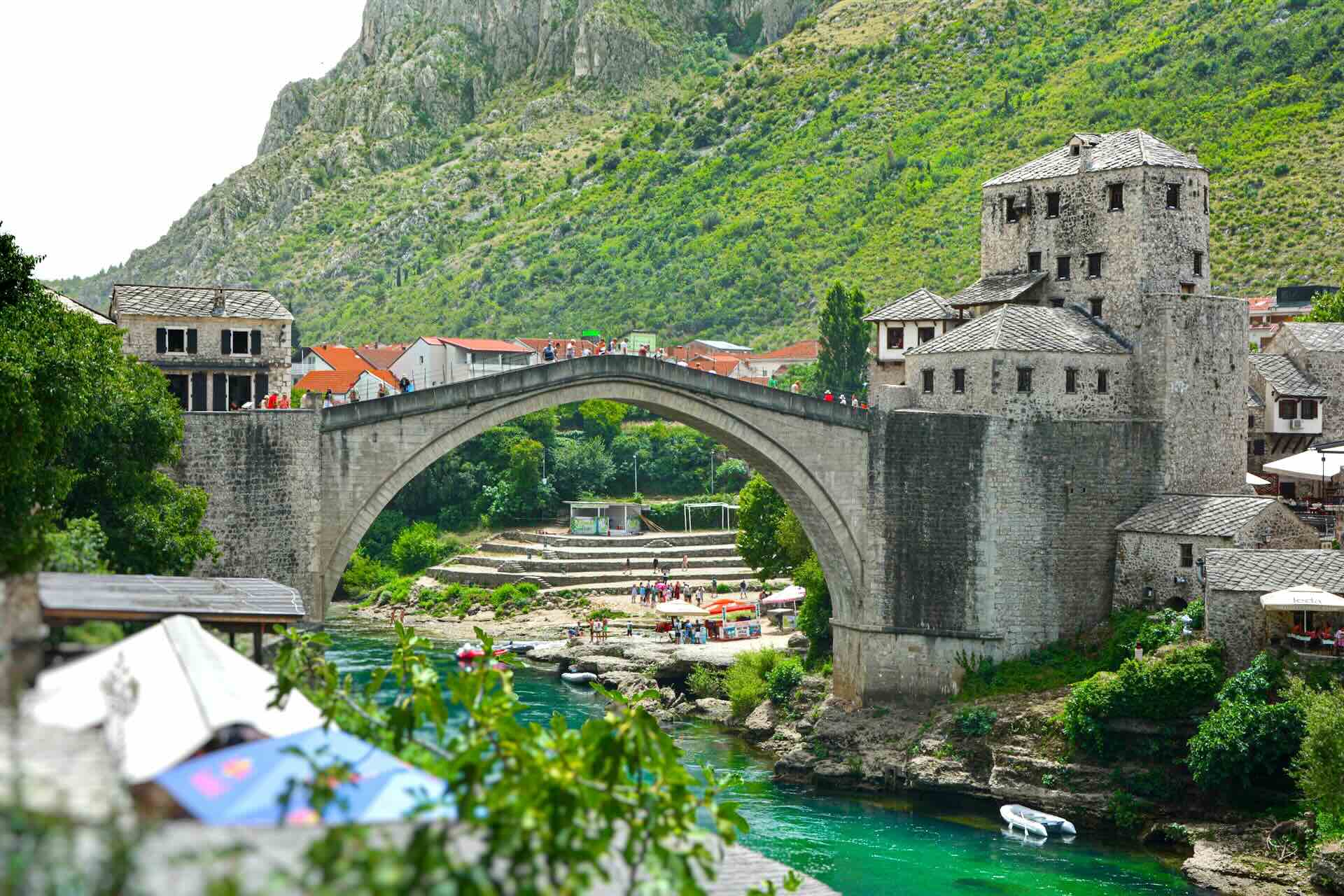
Mostar, Bosnia and Herzegovina a bridge between cultures feels visually dramatic and emotionally layered from the moment you see the Neretva cutting through the city. Mostar’s historic identity is closely tied to the Old Bridge, Stari Most, and to a townscape shaped by Ottoman and later Austro Hungarian influence. The city feels intimate in scale, yet large in emotional presence, with stone streets, river views, and a sense that history here is never far from the surface.
Why Mostar Feels So Distinct
Some historic cities impress through monuments alone. Mostar works through symbolism, geography, and atmosphere at the same time. The river gives the city a dramatic centerline, and the bridge gives it meaning beyond architecture. This is a place where stone, water, and memory all carry weight.
That is part of what makes Mostar so memorable. It is beautiful, clearly, but it is not beauty without context. The old town, the riverbanks, and the bridge itself all suggest connection, division, recovery, and endurance. Very few places carry those ideas so visibly.
The Old Bridge as the Heart of the City
Stari Most defines Mostar. The bridge is the city’s emotional and visual center, and everything around it seems to draw strength from that presence. It is an architectural icon, but it is also something more human and symbolic, a structure that has come to represent resilience and the possibility of reconnection.
What makes the bridge so powerful is that it works on several levels at once. It is elegant in form, dramatic in setting, and rich in meaning. The arc over the Neretva gives Mostar its most unforgettable image, but the bridge also gives the city its deepest sense of identity.
A City Shaped by the River
The Neretva does more than add scenery. It shapes the entire experience of Mostar. The river cuts through a deep valley, and the old city gathers around that geography in a way that makes every viewpoint feel more dramatic.
This geography gives Mostar an intensity that many small historic towns do not have. The city feels concentrated. The river below, the arch of the bridge, and the old stone streets above all work together to create a setting that feels theatrical, but still real.
Ottoman Roots and Layered Identity
Mostar’s old town carries a strong Ottoman imprint, and that gives the city much of its character. Stone lanes, historic houses, old market streets, and the overall rhythm of the urban fabric reflect a cultural world that still feels present in the city’s atmosphere.
That combination matters because it keeps Mostar from feeling one note. The city is not only Ottoman, not only Balkan, and not only Mediterranean. It sits at a cultural meeting point, and you can feel that in the architecture, the street life, and the broader atmosphere. This layered identity is what makes the title a bridge between cultures feel genuinely earned rather than simply poetic.
The Old Town and the Pleasure of Walking
Mostar is best experienced on foot. The old center is compact enough to absorb slowly, and walking allows you to notice how the city changes from one angle to another. Narrow lanes open toward the bridge. Stone houses, small shops, and river views create a rhythm that feels both historic and lived in.
This kind of walking matters in Mostar because the city’s appeal is not limited to one postcard view. The bridge may be the anchor, but the wider urban fabric is what gives the city depth. It is the relationship between the bridge and the surrounding streets that makes the experience feel complete.
A Bridge With Living Traditions
Mostar’s identity is not only architectural. It is also social and performative. The tradition of diving from the Old Bridge into the Neretva has long been associated with courage, spectacle, and local identity, and it adds another layer to the city’s connection with the bridge.
That tradition makes the bridge feel even more alive. It is not just something to admire from a distance. It remains part of the city’s living culture. Even when visitors do not witness a dive themselves, the knowledge that the bridge continues to function as a stage for ritual and local pride gives it more energy and meaning.
More Than a Symbol of the Past
It would be easy to approach Mostar only through the lens of history and conflict, but that would miss the city’s present day atmosphere. Mostar is also social, walkable, and visually inviting. Cafés, terraces, and market streets give it everyday warmth. The city’s beauty is not only solemn. It also includes hospitality, movement, and the pleasure of being beside the river as the light changes.
That balance is important. Mostar carries memory, but it is not trapped by it. The city feels reflective, yet still open. That is part of what gives it lasting emotional force.
Why the Multicultural Story Matters
Mostar’s deeper significance comes from more than the bridge itself. The city feels like a meeting point, where different histories, faiths, and cultural influences have all left visible marks. This is not abstract. It is present in the architecture, the urban layout, and the emotional tone of the place.
This is one reason Mostar resonates beyond its size. The city’s importance is not only visual or historic. It is also symbolic. For travelers who care about places with deeper meaning, Mostar offers something stronger than surface charm.
When Mostar Feels Best
Mostar works especially well when the weather supports long walks through the old town and lingering by the river. In those conditions, the bridge, the stone streets, and the surrounding hills feel especially vivid. Still, the city’s appeal does not depend only on ideal weather. Its deeper power comes from setting, symbolism, and structure.
Travelers who stay long enough to move beyond the bridge viewpoint often get more from Mostar. The city reveals more when treated as a place to absorb slowly rather than just photograph.
Who Mostar Is Best For
Mostar suits travelers who appreciate places with history, atmosphere, and visible cultural depth. It works especially well for people who enjoy walkable old towns, meaningful landmarks, and destinations that feel emotionally charged without becoming inaccessible. Couples, solo travelers, and culturally curious visitors can all do well here.
It is also a strong choice for travelers who want a city that offers beauty with context. Mostar is scenic, but it is not shallow. That makes it linger in memory more than many cities of similar size.
The Lasting Appeal of Mostar
Mostar stays with people because the bridge at its center means more than crossing from one side to another. The city carries visible layers of coexistence, memory, and resilience, and all of that gives the place a power that goes beyond architecture alone.
That is what makes Mostar more than a beautiful stop in Bosnia and Herzegovina. It feels like a city where geography, architecture, memory, and identity all meet in one visible form. For travelers who want beauty, meaning, and a place with real symbolic weight, Mostar offers one of the most memorable urban experiences in the Balkans.